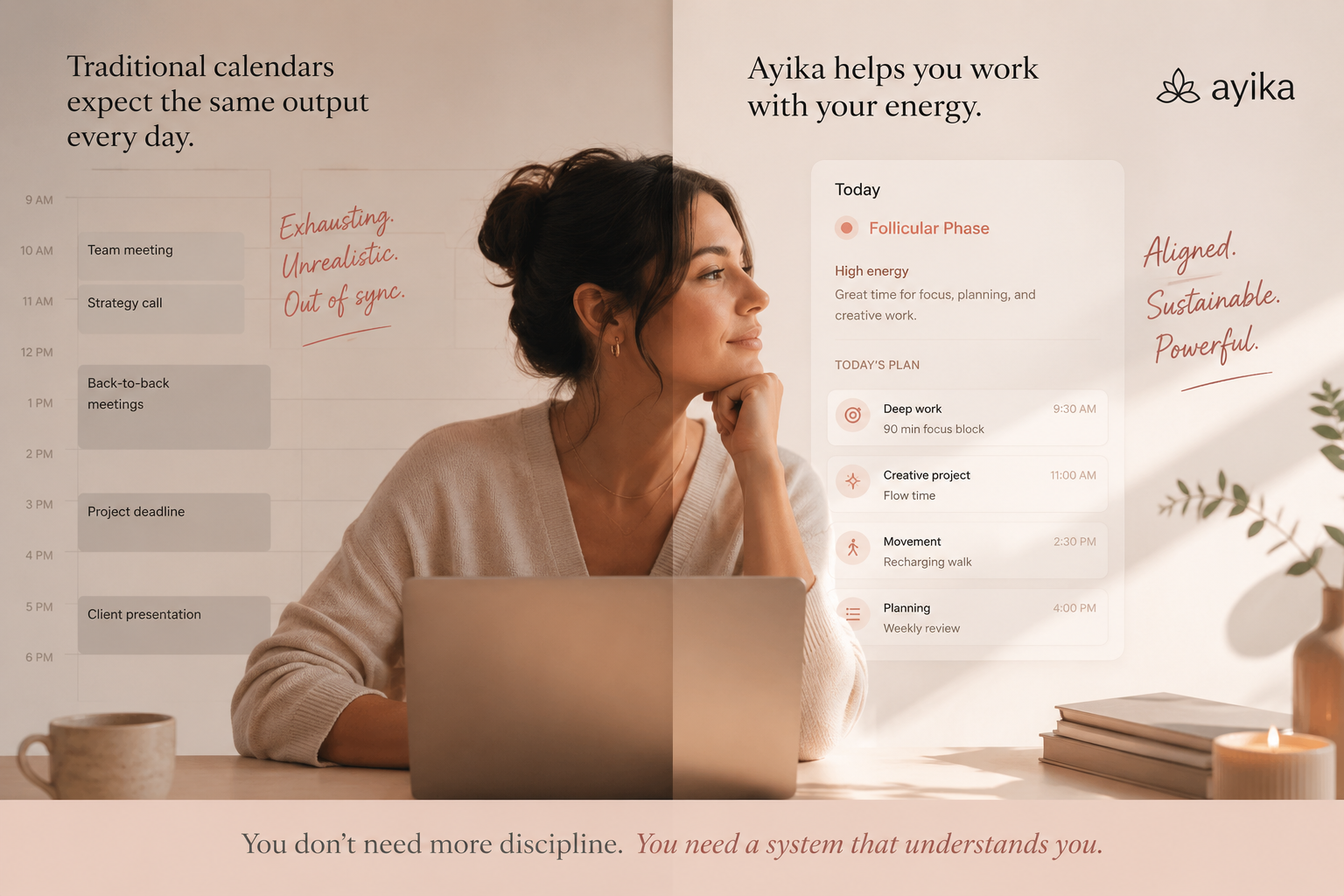
Women are expected to perform at a consistently high level every day.
To lead meetings. Deliver results. Stay organised. Stay switched on.
Often while managing careers, businesses, relationships, caregiving responsibilities, and their own wellbeing at the same time.
But energy isn't static.
Most women know that some days feel better for presenting, networking, brainstorming, and making big decisions. Other days are better suited to focused work, tying up loose ends, or taking things a little slower.
Yet most calendars make no allowance for this.
Productivity tools are built around the assumption that every day should look the same. The reality is that many women experience natural shifts in energy, focus, confidence, and capacity throughout the month. Instead of working with these rhythms, they're often encouraged to ignore them and push through.
The cost is significant.
Around 1.8 billion women worldwide experience menstrual cycles, yet very few workplace systems acknowledge them. Research suggests women lose the equivalent of around nine working days each year due to period-related symptoms, while many more continue working through fatigue, pain, brain fog, and burnout.
This isn't just a health issue. It's a productivity issue.
We're constantly being told to optimise our schedules, manage our time better, and fit more into our days. But what if the problem isn't effort? What if it's timing?
That's where Ayika comes in.
Ayika helps women plan around their natural rhythms by bringing cycle awareness directly into the calendar. Instead of treating every day the same, Ayika helps users understand when they may be best suited to planning, creating, presenting, focusing, or resting.
Not because women are less capable on certain days, but because different phases often lend themselves to different types of work.
The goal isn't to do less.
The goal is to work more intentionally.
At its heart, Ayika is built on a simple belief: planning should work with your energy, not against it.
Because sustainable performance doesn't come from constantly pushing harder. It comes from understanding your rhythms and using them to your advantage.